
Graham Farish N Gauge 371-137TLS Class 31 31407 Mainline Freight DCC Sound Loco
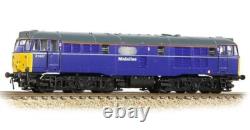

Perfect addition to N Gauge model railway layouts, ideal for N scale model train collectors and British railway modelling enthusiasts looking for detailed locomotives. N Gauge Graham Farish Class 31 diesel locomotive - DCC sound fitted and ready to run on your model railway layout. This detailed N scale model railway locomotive is supplied DCC sound fitted, bringing authentic diesel sounds and lighting functions to your layout straight out of the box. The model represents a refurbished Class 31/4 fitted with Electric Train Heating, featuring plated headcode boxes, radio pods and other characteristic details of the later locomotives.
N Gauge / N Scale (1:148). Graham Farish detailed locomotive model.
DCC sound fitted (Zimo sound decoder installed). Coreless motor for smooth running. Directional lighting (headlights, markers and tail lights). The British Rail Class 31 locomotives were built by Brush Traction between 1957 and 1962, with 263 produced. Originally introduced as part of BR's dieselisation programme, they later appeared across several regions of the UK and remained in service for decades.
N Gauge model railway layouts. This model, which will be available from retailers in the South of England, depicts Refurbished Class 31/4 No. Depicting a Class 31/4 which was fitted with Electric Train Heating, this model also sports all the hallmarks of a refurbished machine with its bufferbeam cowling and bodyside band removed, headcode boxes plated over and radio pods present above each cab.
The vibrant blue livery is expertly applied and is only accented by the orange cantrail stripe and the silver insignia and running number. Fitted with high intensity headlights at each end, which of course are functional, the model also features working tail and marker lights.
Suitable for use on DCC or analogue control straight out of the box, this. Model will take your enjoyment to the next level with its authentic sound effects which only enhance the model's good looks! Directional Lighting - independently switchable at each end via switches mounted on the circuit-board, or via DCC. Fitted with a Zimo MX659N18 Sound Decoder - See below for the function list. Sales Area Exclusive Model - available from retailers in this area (see map for more details). F1 - Engine Start (Sound On/Off). F3 - Single Horn (Speed and Direction Related). F4 - Two-Tone Horn (Speed and Direction Related). F8 - Cold Start (F8 On before F1). F9 - Flange Squeal (Speed Related). F15 - Cooler Group Fan. F17 - Auto Wagon Buffering (F17 On & F5 Off only). F18 - On - Driver's Door Opening / Off - Driver's Door Closing. F19 - Fade All Sounds. F20 - Directional Lights Off - No. F21 - Directional Lights Off - No. F22 -'Right o' way.Analogue Users: Directional lights and basic Prime Mover (engine) sounds, which vary with speed, plus any other automated sounds, can be enjoyed when using this model on analogue control (DC) straight from the box! The first Class 31 entered service in November 1957 and the design was one of the Pilot Scheme locomotives ordered by British Railways to replace steam traction. The Class was originally allocated to the Eastern Region, but gradually became common on both the Western and London Midland regions too.
The Class 31/1s were the standard locomotives, distinguished from the first batch of locos - the 31/0s - which had Red Circle multiple-working control equipment, a non-standard feature that led to them being withdrawn relatively early in the late-1970s. The 31/1s were fitted with Blue Star multiple-working equipment, as found on many other BR classes, and all had steam heating boilers from new, making them ideal for hauling passenger services.
Commonly used in East Anglia, with allocations at Stratford and March depots, they were also found throughout the Eastern Region of BR with Finsbury Park sporting a large allocation, along with the depots at Tinsley, Immingham and Thornaby. Examples were also allocated to Bristol Bath Road and Old Oak Common on the Western Region, where they could be found working passenger trains as far west as Barnstaple and Paignton. In the early 1980s, Healey Mills and Bescot on the Midland Region also gained an allocation as replacements for Class 25s. During the 1970s some Class 31s were fitted with Electric Train Heating (ETH) and these were reclassified as 31/4s to denote this feature.The 1980s would see BR undertake a programme of refurbishment for much of the fleet, this included the fitting of ETH to more locomotives but refurbishment was not reserved exclusively for the 31/4s, Class 31/1s were also refurbished without receiving ETH equipment. During refurbishment bufferbeam cowlings were removed along with the bodyside band, headcode boxes were plated over and fitted with two marker lights, and any remaining disc headcodes were removed. Where steam heat boilers remained, these were removed and a concrete block added instead to maintain the weight balance. As passenger work dried up, many of the 31/4s were displaced and found themselves allocated to the departmental sector. In 1990, to reduce maintenance costs and prevent their ETH-fitted locos being borrowed for passenger work when extra traction was needed, the departmental sector isolated the ETH and removed the jumper cables from some of its 31/4s, resulting in these locos being reclassified as 31/5s.
There were also two locomotives classified as 31/6, these had through ETH wiring fitted allowing them to work double-headed with an ETH-fitted loco. Other operators however kept Class 31s active on the mainline and in 2022 it is still possible to see a 31 on the mainline.The Class has also been popular with the preservation movement, with more than 25 examples now preserved.