
Graham Farish 372-916SF LMS 10000 BR Lined Green Late DCC SOUND FITTED N GAUGE
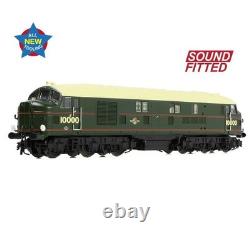

We are continuing to take and despatch orders throughout the holiday period, subject to available post collections. Graham Farish 372-916SF LMS 10000 BR Lined Green Late DCC SOUND FITTED - N GAUGE - NEW.
Brand new model in original packaging, supplied to us direct from Bachmann. The model and prototype information below is taken from the Bachmann website.
The LMS'Twins' - Nos. 10000 and 10001 - were the very first mainline diesel locomotives built in the UK and now, this pioneering pair is available in N scale for the first time thanks to Graham Farish. 10000 depicts the first of the'Twins' during the period after its time on the Southern Region - between 1953 and 1955 - when the two locomotives were trialled on the SR alongside the Southern's own prototype diesel locomotives.
The Graham Farish model of No. 10000 is a highly detailed masterpiece in miniature, adorned with numerous separately fitted components to accurately capture the appearance of this pioneering machine. The livery application captures the splendour of the prototype, whilst engine room detailing has been replicated through the bodyside windows for the first time. Inside, the proven combination of a coreless motor and twin flywheels, driving both bogies and with all-wheel drive will provide enough power for any prototypical train. Supplied with SOUND FITTED, this model is supplied equipped with a DCC sound decoder which will play realistic sound effects straight out of the box - whether you're running on analogue or DCC! 10001, the LMS Twins will make the perfect addition to any BR-era layout. Pristine BR Lined Green (Late Crest) livery. SOUND FITTED - Fitted with a Zimo MS590N18 DCC Sound Decoder - See below for the function list. DETAIL VARIATIONS SPECIFIC TO THIS MODEL. Six Headcode Lights & Brackets at each end. GRAHAM FARISH LMS 10000 & 10001 SPECIFICATION. Coreless, twin shaft motor with two flywheels providing drive to both bogies. Separate metal bearings fitted to each axle. Gearing arranged for prototypical running speeds and haulage capabilities. 9mm (N gauge) wheels to NEM310 standards with authentic profile and detailing. Removable coupling pockets to NEM355 standards fitted to each bogie. Designed to operate on curves of second radius (263.5mm) or greater.Bogies constructed from multiple components featuring full relief detail, including separately fitted metal sand pipes. Separately applied underframe and roof detail components. Separate lamp irons fitted to each nose. Each model supplied with a full set of model-specific bufferbeam pipework and accessory parts. Directional lighting, switchable on/off at either end on DCC or Analogue control.
Cab lighting, switchable on/off (leading end, when used on DCC only). Authentic light colours and temperatures selected for each model based on era and application.
Speaker installed in all models for optimum sound reproduction. Zimo MS590N18 DCC Sound Decoder fitted to SOUND FITTED versions.Sound files produced specifically for the Graham Farish LMS 10000/10001 using recordings from real locomotives. SOUND FITTED models operate on DCC and Analogue control as supplied.
Authentic liveries applied to all models. Multiple paint applications employed on each model using BR specification colours. Logos, numerals and text added as appropriate using multi-stage tampo printing using authentic typefaces, logos and colours.F0 - Directional Lights - On/Off. F1 - Sound - On/Off. F8 - Cold Engine Start (Turn on before F1). F9 - Flange Squeal (Speed Related). F10 - Dispatch Whistle with Driver's Response.
F15 - Cooler Group Fan. F17 - Automatic Wagon Buffering. F18 - On - Cab Door Open / Off - Cab Door Shut.
F19 - Fade All Sounds. F20 - Directional Lights Off No. F21 - Directional Lights Off No. F23 - Cab Light (Leading End Only). F25 - Detonators (Speed Dependant).
F26 - Shunt Mode (Half Speed, No Inertia). Analogue Users: Please note that normal load running sounds and any other automatic or randomised sounds will also operate when this model is used on analogue control (DC) straight from the box! LMS 10000 & 10001 CLASS HISTORY. 10000 and 10001 were the first mainline diesel locomotives built in Great Britain. A joint venture between the London, Midland & Scottish Railway (LMS) and English Electric, the pair were first conceived in 1946.
The body and chassis design was undertaken by the LMS's Chief Mechanical Engineer H. Ivatt, and English Electric provided the engine, electric systems and machinery.
10000 began at Derby Works in 1947 and the locomotive was outshopped in December of that year, days before Nationalisation of Britain's railways. Both locomotives entered traffic in an eye-catching black and silver livery, with large chrome numbers fitted at each end of the bodysides, below the cab windows. The letters LMS were also applied in chrome to No.
10001 did not enter service until mid-1948, with British Railways completing its construction, and so it entered traffic with neither LMS nor BR markings. The locomotives worked both singularly and as a pair on the Midland Main Line and West Coast Main Line, hauling named expresses and lower key services, and venturing north of the border into Scotland. Interconnecting doors were fitted within the noses of each engine, allowing crew and personnel to move between the two in motion, but this feature was seldom used.
In 1953 the Twins were sent to the Southern Region, being fitted with an additional pair of marker lights and lamp brackets beforehand which made them compatible with the SR's practice of using headcodes to denote both train types and routes. During a two year period on the Southern Region the Twins worked alongside the Southern's own diesel prototypes before returning to the Midland Region in 1955.
As prototypes, changes and modifications were made to the locomotives during the years and this included the fitting of water scoops to allow water for the steam heat boiler to be collected from troughs located between the rails'on the move'. By the late-1950s new, production series diesel locomotives were arriving en-masse and whilst their time in service had been highly educational and helped to shape the BR diesel fleet, the writing was on the wall for this pair on non-standard prototypes. 10000 was officially withdrawn in December 1963, whilst No.
10001 lasted to March 1966, kept going with components salvaged from its Twin. Sadly, neither was saved and both were subsequently scrapped, but their legacy carried on in the Class 40s, 50s and 56s which all used versions of the English Electric 16SVT engine and today, works is ongoing to build a replica of No.