
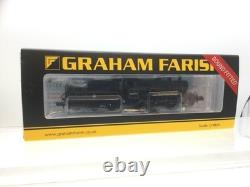
Graham Farish 372-626ASF N Gauge BR Black (E) Ivatt 2MT 46477 DCC SOUND
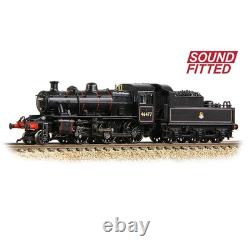
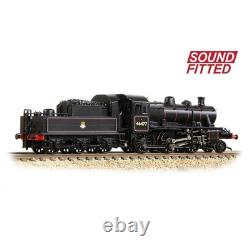
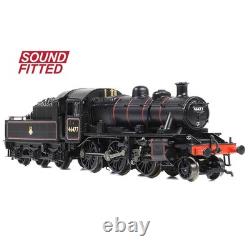
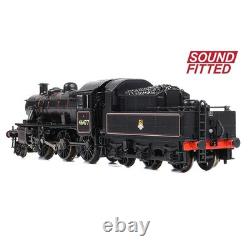
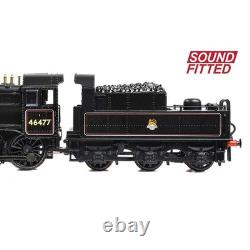
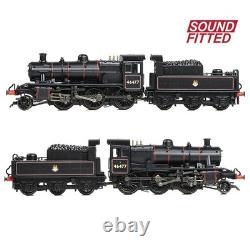

PLEASE REVIEW THE PHOTOGRAPHS AS WELL, ACCESSORIES/BOXES ETC WILL BE SHOWN IF THEY ARE INCLUDED. Both upgrades are used to their full potential in this. 46477 in BR Lined Black livery with Early Emblem. This Award Winning model certainly packs a punch when it comes to the detail, with separate metal handrails found throughout the locomotive and tender, lubricators and sand boxes along the running plate and separate pipework running from below the cab to the top feed on the boiler.
The turned brass safety valves and whistle contrast beautifully with the firebox on which they are mounted, whilst inside the cab, the moulded back head detail has been decorated to pick out the individual gauges and controls. A hinged tender fall-plate provides the finishing touch to the highly impressive cab of this model. When it comes to performance it's hard not to marvel as you watch the Walschaerts valve gear in motion. The powerful coreless motor provides drive to the centre pair of driving wheels, whilst all six driving wheels are fitted with separate metal bearings and a pair of traction tyres are fitted to the rear driving wheels to aid traction.
Electrical pick-up comes via all six driving wheels and all six tender wheels, with a semi-permanent loco-tender coupling system to ensure the two stay firmly coupled at all times. You can start enjoying authentic sound effects as soon as you place this model on your layout - whether you operate using DCC or Analogue control! Additional traction tyres are available separately (379-423), along with the ModelMaker N Scale Loco Crankpin Box Spanner (MM027) - an essential part of any N scale tool kit. Pristine BR Lined Black (Early Emblem) livery.Fitted with a Zimo MS590N18 Sound Decoder - See below for the function list. F1 - Sound On / Sound Off.
F3 - Cylinder Drain Cocks. F4 - Single Whistle (Speed Related). F9 - Flange Squeal (Speed Related). F11 - Handbrake (locomotive will not move with the handbrake applied).
F12 - Water Tank Filling. F14 - Light Engine Mode. F15 - Fade All Sounds. F16 - Guard's Whistle.
F17 - Automatic Wagon Buffering. F19 - Pinned Brakes (F18 must be On). F21 - Short'Toot Toot' Whistle. F22 - Long Duration Whistle.
F23 - Short Duration Whistle. F24 -'Clear from the Guard. F25 -'Going under Charlie. F26 - Guard to Driver Instructions.
A selection of different instructions can be selected via CV changes. Analogue Users: Normal-load running sounds, acceleration steam chuff sounds and any other automatic and randomised sounds can be enjoyed when using this model on analogue control (DC) straight from the box! With construction commencing in 1946, just twenty examples were built by the LMS and the remaining 108 were outshopped by British Railways following Nationalisation in 1948. The construction programme was completed in 1952 and these Mixed Traffic locomotives would go on to operate on all the BR regions, with the exception of the Southern.
Light axle loadings allowed the Ivatt 2MTs to be used on most routes including branch lines, where their almost enclosed cabs made them ideal for working tender first when no turning facilities existed. The design provided the basis for the BR Standard Class 2MT 2-6-0, and the two are very similar in appearance, with the Standard version having only a modified cab and tender profile to allow unrestricted route availability across the British network. The Mogul's versatility and its relatively modern design however ensured that many examples were still in traffic until the mid-1960s, but by 1967 all had been withdrawn. Thankfully, seven Ivatt 2MT have been preserved and the type is an ideal source of motive power for many of the trains running on heritage railways today.